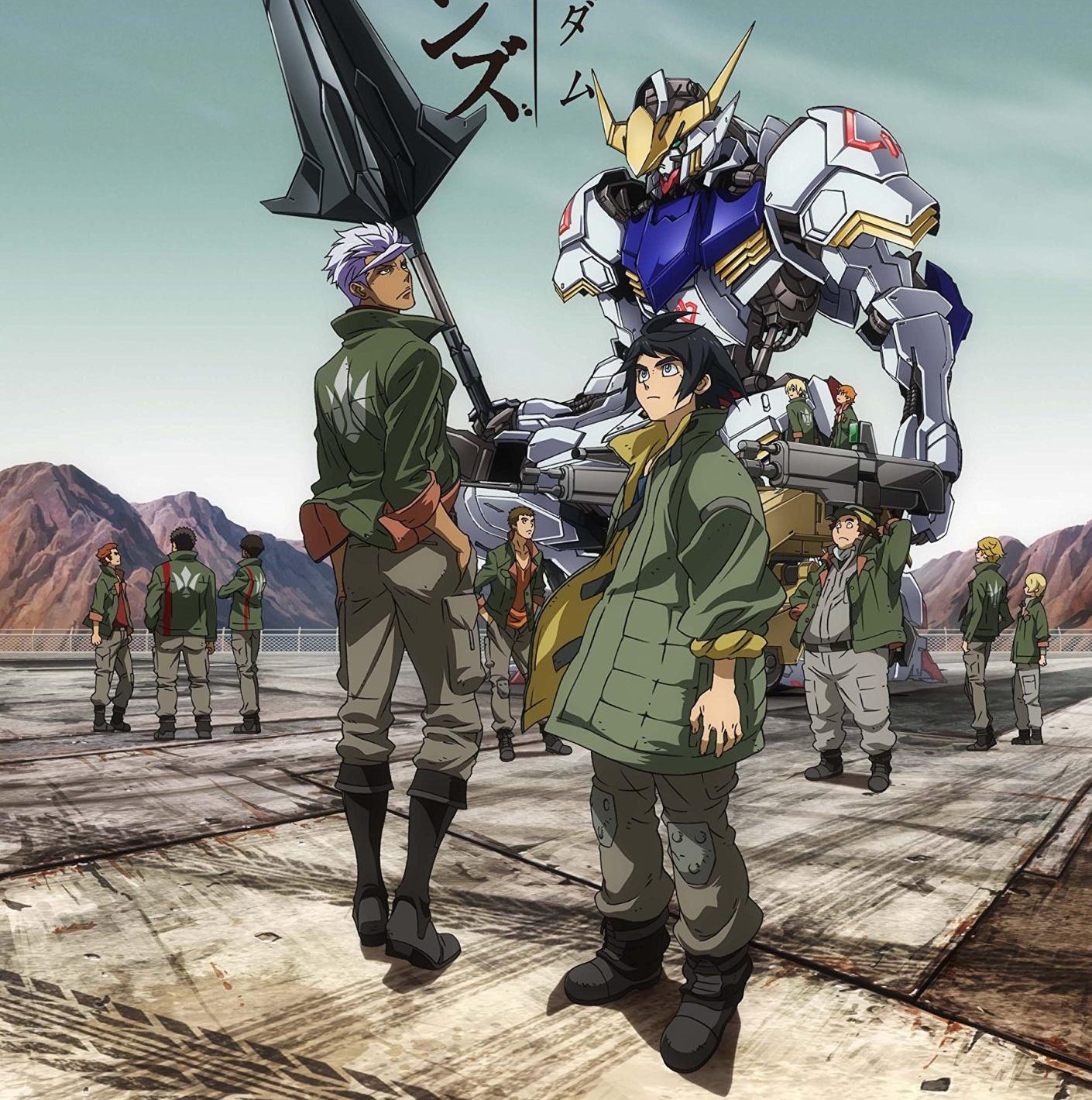
What is MSG: Iron Blooded Orphans?
MSG (Mobile Suit Gundam): Iron-Blooded Orphans is an anime ran through October 4, 2015 – April 2, 2017, having two seasons. It’s the fourteenth mainline entry in Yoshiyuki Tomino’s original series, Mobile Suit Gundam, released in 1979. MSG Iron-Blooded Orphans goes by two simpler names, “Gundam IBO,” and “G-Tekketsu,” G-Tekketsu being the original teased name for the series.
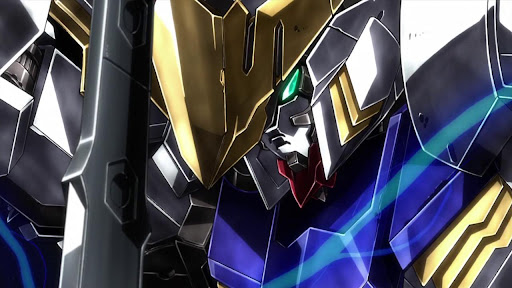
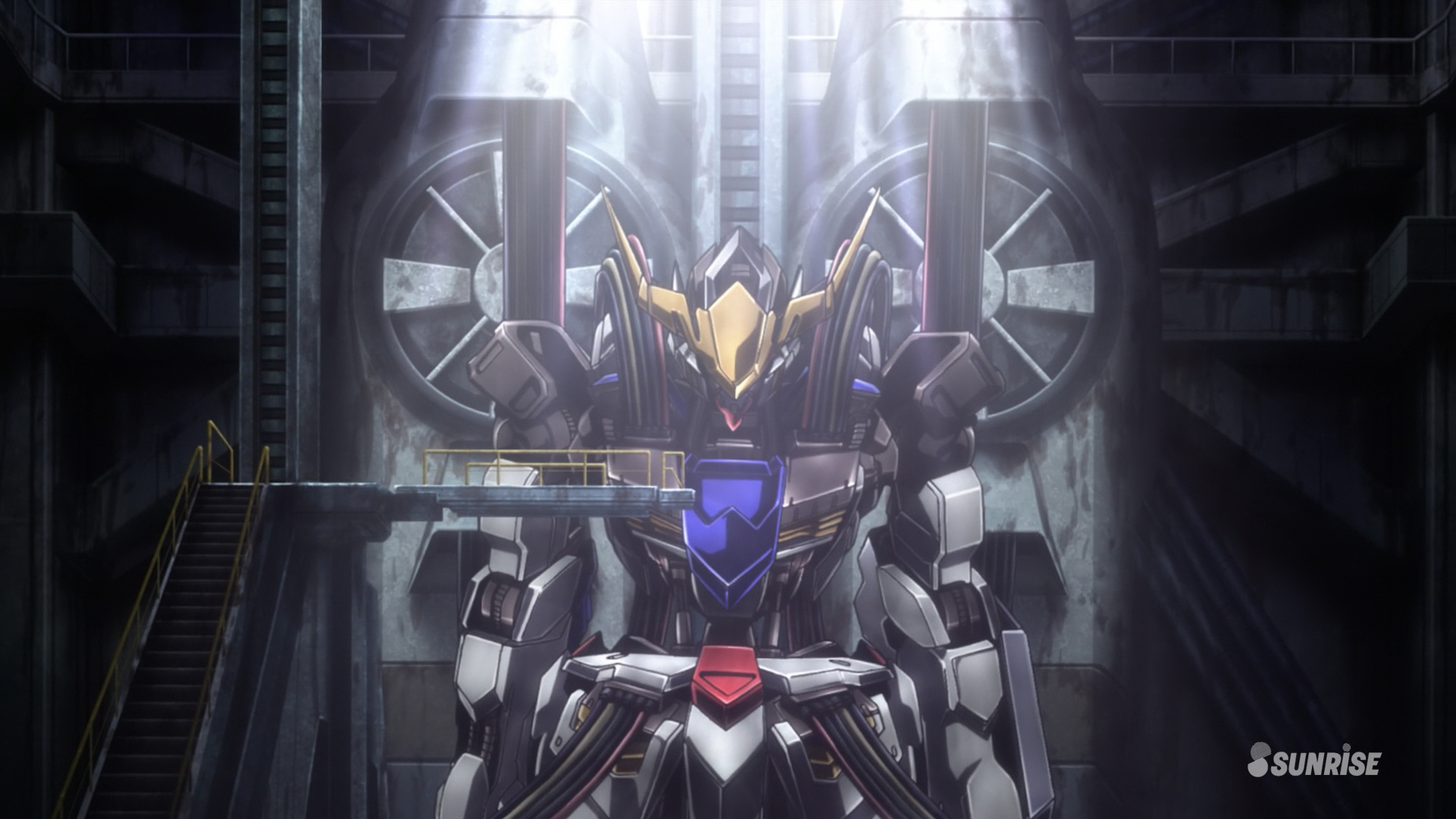
Gundam Barbatos (First Form) under CGS base
The story is set in an age 300+ years after an interplanetary conflict called the “Calamity War.” It explores a group of exploited juvenile soldiers who are enslaved to work on Mars, an autonomous planet that wishes to be separated from Earth’s government. Kudelia Aina Bernstein, a Martian noblewoman, employs a civilian security company called Chryse Guard Security (CGS) to escort her to Earth so she can negotiate the independence of her planet and nation. But, before she can leave the planet, an Earth military organization called “Gjallarhorn” attacks CGS in an attempt to halt the Martian independence movement. During the battle, a one-sided war is ever present, causing the higher-ups of CGS to flee and leaving the enslaved children in their vehicles of war, Mobile Workers, to fight and protect the main base. This cowardice causes Orga Itsuka, the leader of the Third Army Division within CGS—composed of children—to rebel against the adult higher-ups who had abandoned them and gain ownership of the company.
During the Mobile Worker battle, Gjallarhorn deploys three Mobile Suits, humanoid piloted robots that dwarf the Mobile Workers in size, turning the battle completely in Gjallarhorn’s favor. But when all hope is lost, Orga’s closest friend—and orphan—Mikazuki Augus, enters the battlefield in the CGS’s power generator—a relic of the Calamity War: the ASW-G-08 Gundam Barbatos. With the power of the Gundam Barbatos, CGS was able to make Gjallarhorn retreat their forces; eventually leading to the Barbatos being labeled as a “Demon.” After repelling Gjallarhorn’s forces, Orga and the Third Army Division dispose of the adult higher-ups and take control of CGS, refounding it as the mercenary company “Tekkadan” (Japanese for “Iron Flower.”)
What does Gundam IBO cover story-wise?
Gundam IBO covers several sensitive topics, like slavery, genocide, and political conflicts. Gundam IBO portrays its concepts in beautiful, thoughtful ways. They aren’t afraid to end off characters that the audience likes, but shows how it affects everyone impactfully. You grow a deep sense of connection with Tekkadan. Even its leader, Orga himself—calling them all a family. You come to root for these children, as they try and create a world they can call home. And even at a disadvantage, they find a way to come back—even on the brink of death—showing the dedication and will Tekkadan and the people within the group have to survive as a group, and a family, in a world that wants to destroy them.
Even organizations that are seen as antagonists have complex relations. You can tell how the world has shaped itself from how the modern slaves of the solar system see themselves, and how the companies that own them treat them. But the show doesn’t treat everyone with pity, it proves that not everyone is able to be saved, and that some are better off passing beyond, and never rescued in the first place. It tackles complex emotional issues, between the ones that are struggling and the ones that aren’t. It’s not hesitant in showing despair, hatred, victimization, and everything negative. Even with this, it still leaves so much to be able to decipher yourself: like why companies do certain things, how the Earth’s governments work, or why a character acts a certain way in a tense situation. MSG: Iron-Blooded Orphans is able to string together a story that has a perfect balance of instability, a deep, throbbing sense of realism in a world that is far from realistic in ours.
Animation, Sound Design, and Designs.
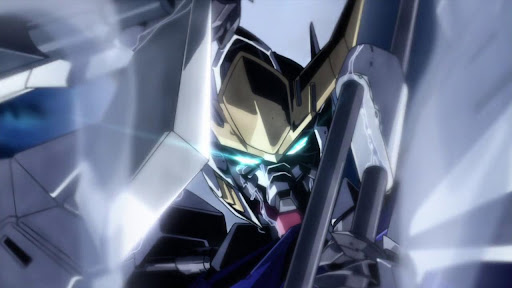
Gundam Barbatos (6th Form) VS Graze Ritter (Carta Ver)
MSG: Iron-Blooded Orphans isn’t afraid to show how dated it looks, but still uses it to make some of the most engaging scenes in Gundam.
Gundam IBO has a unique animation style compared to other entries in the Mobile Suit Gundam series. It uses a lot of still-frames, mixed with fully animated segments to give the Mobile Suits and weapons shown a heavy feel to them. With their use of glowing effects and sparks, it creates eye-catching visuals that are usually unforgettable in how they’re composited. Yet what brings the animation together is the sharp, commanding, and opposing use of sound design and soundtrack. The sounds of weapons hitting Mobile Suits and vehicles are sudden, loud, and echoey, making each hit feel powerful, destructive, and deadly. Mixed with the soundtrack, a wonderful mix of instruments and digital alteration, it’s clear to know when someone big has entered the battle, or expose the high points and lows of the most tense moments. It’s a destructive mix that comes together and makes Iron-Blooded Orphans especially unique, as it’s something you won’t just forget. It emphasizes the show’s feel, its grit, blood, and wounds.
Why should you watch MSG: Iron Blooded Orphans?
Gundam IBO is a deep, thoughtful narrative that tackles the realities of war. It’s an amazing example of how battle and power can shape wars. It doesn’t like being kind, nothing is forgotten and like war, you can lose everything before you can even watch it get taken. It has a darker, realistic, but hopeful story mixed with exciting Mobile Suit fights. It’s all a chaotic mix, a mix that most people come to enjoy and love, including myself when I first watched it. It has a beautiful story, engaging cinematics, a wonderful soundtrack, and a setting that’ll strike close to home while being so far at the same time. If you enjoy a mix of psychological and action, with characters you can come to love and hate, watch Mobile Suit Gundam: Iron-Blooded Orphans.